

In Episode 14 of Liberty and Justice For All, Debra Lancaster joins Michael Merrill and Egberto Willies to examine an economy that depends on caregiving while leaving families and care workers struggling. Check it out. A slightly edited transcript is also available here. Below, I offer a bit more background.
The United States is the richest country in the world in terms of its total output and income, and arguably the richest, most productive country in the world even on a per person basis, if you put aside the small countries that rank ahead of it in terms of per person income the primary products of which are financial services, tax shelters, and non-renewable fossil fuels.
Despite being the richest country in the world, more than one out of every three american children (approximately 35 percent) live in low-income households, defined as families earning less than 200% of the Federal Poverty Level (FPL).
If we include ALICE families—those that are “Asset Limited, Income Constrained and Employed” but don’t earn enough to afford basic monthly necessities—then the percentage of American children who live in households where their caregivers are stressed to provide what they require rises to 50 percent.[1]
And these proportions are only overall averages. Due to long-term wage gaps and wealth discrepancies, Black, Hispanic, and Native American households, which represent one-third of all families, have median family incomes that are only about half of what families earn.[2]
How bad a problem is this. Think of it this way. How bad would it be if we abolished Social Security?
According to the Center on Budget and Policy Priorities, without Social Security the poverty rate for Americans aged 65 and older would skyrocket to almost half of all seniors (47.7 percent under the Supplemental Poverty Measure [SPM], which accounts for out-of-pocket medical expenses and taxes).[3]
That’s how bad it is for parents and children in the US. Neither economic nor social security for half of them and their lives harried, harassed, and hurried. It is no way to ensure that our most vulnerable grow up feeling safe and secure!
As it now stands, total government spending on children and their families, counting federal state and local spending is only half what is spent on older adults. The federal government alone spends roughly 6 to 10 times more per person on seniors (65+) than on children.[4]
It does not have to be this way. The table below compares the percent of its GDP (or national output) spent on childcare, families more generally, and old age pensions and benefits. The US spends about the same as its rich country peers on seniors, but less than half on families and children.
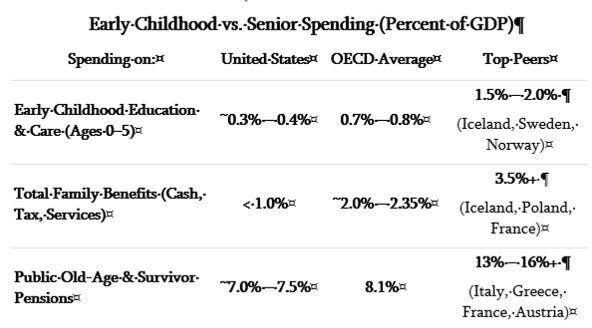
Here are some of the key differences in the way other rich countries provide for families and children compared to the way the US deprives them.
Publicly Funded Child Care: The U.S. ranks near the very bottom of the 38-nation OECD Family Database for early childhood education and care, spending less than half the OECD average as a share of GDP.[5] Because public investment is low, U.S. parents pay the highest out-of-pocket childcare costs in the developed world—averaging 20% of disposable income for a couple with two children, compared to 1% to 10% across most of continental Europe.[6]
National Paid Parental Leave: The United States is the only OECD country without a national, publicly funded paid maternity or parental leave program. In peer nations, wage-replacement leave accounts for a substantial share of early-childhood public spending.[7]
Universal Child Allowances: Most European peers—such as Germany, France, and the Nordic countries—provide universal monthly cash “child allowances” to all families regardless of income, whereas the U.S. relies primarily on tax credits and means-tested programs.[8]
When it comes to seniors, however, the US provides comparable support, even though its medical system is costlier than most. Average public spending on old-age pensions by rich countries is about 8 percent of GDP—more than ten times the 0.7 percent spent on early childhood care.[9]
We shouldn’t begrudge seniors their Social Security and Medicare! But neither should we deprive parents with the economic and social security they need to ensure they can raise healthy, strong, happy, and self-confident children.
Seniors are owed a decent retirement in return for all they have contributed. Children are owed at least as much in return for all they might and will contribute.
Countries like Sweden, France, and Germany treat early childhood as a universal public good and invest 2 to 5 times more of their economic output into infants, toddlers, and preschoolers than the United States. There is absolutely no other explanation for why the US does not do the same but our selfishness and short-sightedness.
We can do better, we must do better.
[1] United for ALICE, “Half of U.S. Children are Living in Financial Hardship,” Alice in Focus: Children September 25, 2024. https://www.unitedforalice.org/news-and-stories-article/93937A0E.
[2] Children’s Defense Fund, “Child Poverty, 2023” https://www.childrensdefense.org/tools-and-resources/the-state-of-americas-children/soac-child-poverty.
[3] Kathleen Romig, “Social Security Lifts More People Above the Poverty Line Than Any Other Program,” Center on Budget and Policy Priorities, February 25, 2026. https://www.cbpp.org/ research/social-security/social-security-lifts-more-people-above-the-poverty-line-than-any-other-0.
[4] Kent Smetters, “How Federal Spending is Distributed by Age,” Penn Wharton Budget Model (April 1, 2026); Peterson Foundation, “How Much Government Spending Goes to Children?” (June 3, 2026); Chad Aldeman, “America’s Budget Prioritizes the Old Over the Young,” Aldeman on Education, (April 8, 2026);
[5] OECD Family Database, “PF3.1 Public Spending on Childcare and Early Education, 2021.
[6] Katharina Buchholz, “U.S. Childcare Cost Higher Than in Other Developed Countries,” Forbes (September 10, 2024).
[7] OECD Family Database, “PF1.6 Public Spending by Age of Children, 2021.
[8] Bi-Partisan Policy Center, “International Investments in Early Childcare and Education,” 2021.
[9] OECD, “Pensions at a Glance 2025;” “Sizing Up the Welfare States: How Do OECD Countries Compare?”