

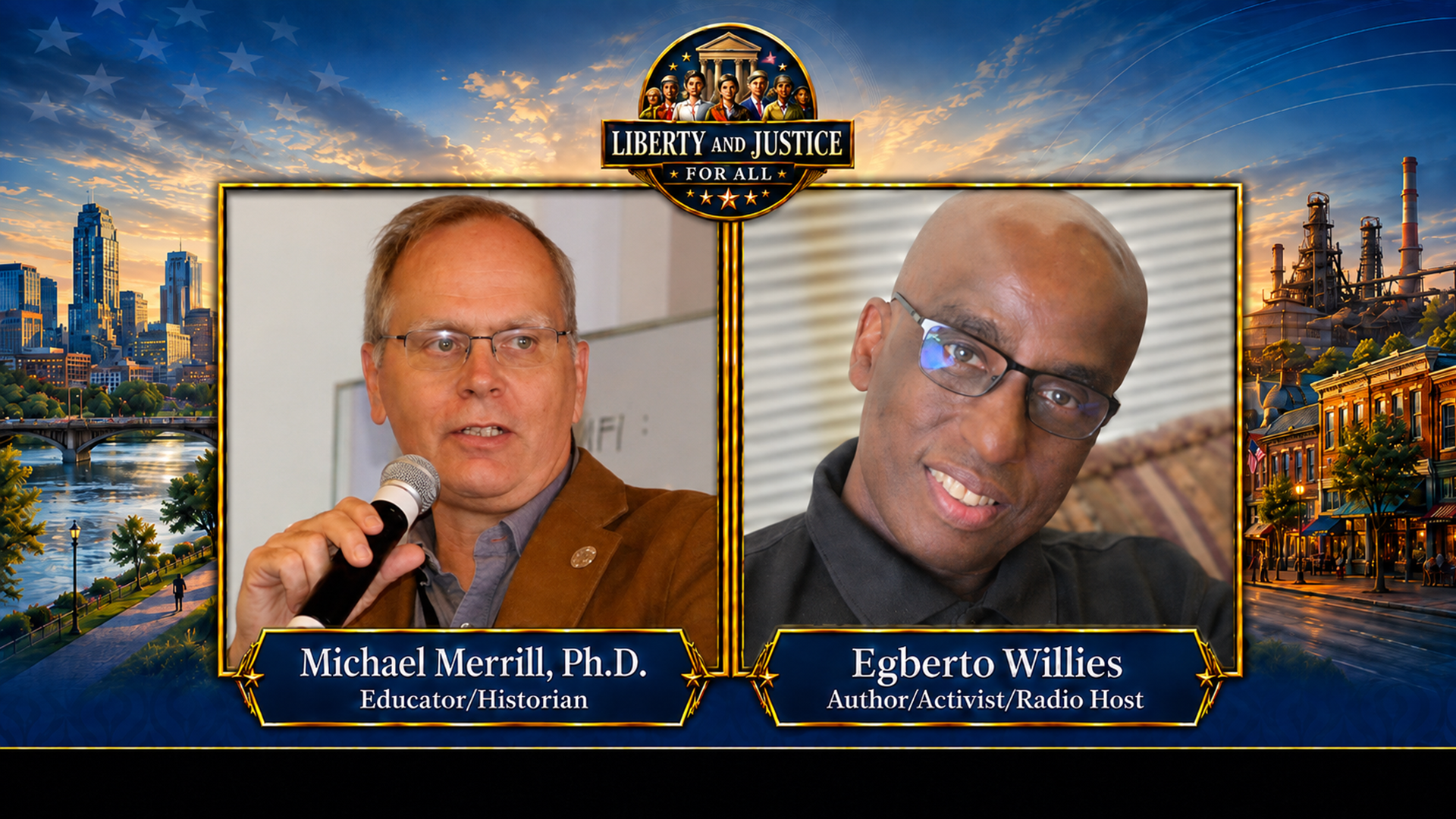
Welcome to “Liberty and Justice for All,” the Substack home of KPFT ‘s weekly radio hour of the same name, which airs Thursdays at 2 PM Central.
The show is co-hosted Michael Merrill (that’s me), currently a Research Fellow at Rutgers LEARN (Labor Education Action Research Network); by Les Leopold, co-founder and executive director of The Labor Institute; and by Egberto Willies, who also produces “Politics Done Right” on KPFT, as well as “Egberto Off the Record” and “Reality Check” with Marlon Weems on Substack. It got started after Les and I had been talking to Egberto, who has followed Les’s column, “Wall Street’s War on Workers,” now subtitled, “Why We Need a Party of Our Own,” on Substack and Common Dreams.
I am going to be taking the lead on the radio show for now, together with Egberto, while Les concentrates on his column, which we will occasionally feature on the show, and whatever his next book project becomes!
KPFT’s program notes describe “Liberty and Justice for All” as focused on “the promise of American democracy,” and Egberto and I share our initial views on this theme in the first programs.
But I am also entering the project with a larger purpose in mind, which I want to share and invite comments upon right off the bat. We need an American civic religion revival, a political Great Awakening, and there is nobody to make one but all of us!
I think nearly everyone agrees that American politics is broken. The question is: what can we do to fix it? The first thing we can do is start talking about solutions and not just the problems.
And I don’t just mean band-aids. I mean real, far-reaching, and meaningful fixes.
A lot of the conversation about fixing our politics focuses on messaging. The idea seems to be that if our side has the right message, it can win. Should it be more conservative? Should it be more centrist? Should it be more populist? That is what everybody is asking themselves.
The problem with this conversation, as I see it, is that it is too often circular. What is the right message? Too often the answer is, whatever message can win! Which gets us exactly nowhere. Winning is only the first step. Essential, to be sure. But what will we do if we win?
Nobody runs on a platform that says, “We will make things worse for you!” They run on, “We will make things better for you!”
But how do they propose to do that? That is the question. Make us safer. How? Make us healthier. How? Make us richer. How?
Those are the things we must talk about. And we need to get into the weeds. Find all the right messages you want. At the end of the day, what people remember is what the messengers did: Whom did they protect? What did they provide? Where did they make things better?
So, what are we going to do? “Liberty and Justice for All” is currently guided by the following initial assumptions.
First, we are not going to fix American politics by being against America. We can criticize it. But we have to do so from a standpoint of love, not hate. Otherwise, it will seem to most people that we criticize to make the country worse, not better.
We need to take back our history from those who tell it as either a story of relentless, unrelenting hate, as too much of the left does, or as a contemporary excuse for cruelty and hate today, as too much of the right does.
The American story is not just about expropriation, enslavement, exploitation, and oppression. It is also a story about cooperation, abolition, equality, and justice. To focus on one side but not the other is neither to tell the whole story nor to learn from it what it can teach.
Second, we are not going to fix what’s wrong with the American economy by simply fine-tuning its parts. The American economy needs more than a tune-up. It needs an overhaul.
But that does not mean getting rid of what works. It means getting rid of what’s broken. So, what’s broken?
What’s broken is that the economy is not run by and in the interests of all of us. On the contrary, it is run by and in the interests of only some of us.
Which some? Follow the money. The average income of every fifth of income earners, from the bottom to the top, has doubled since 1980. That’s the good news. But the average income of the Top 1 Percent, the richest of the rich, quadrupled over that same period.
That’s the bad news. If the Top One Percent (let’s call it “The Moneyed Class”) had done no better than the rest of us (let’s call us “The Middle Class and Working Classes”), then the average income of all of us would be even higher.
Of course, none of us are average. All of us are somewhere on the spectrum, and what happens to the average does not necessarily happen to any of us. And many of us are now worse off than we were, certainly than we would have been, if the economy worked for all of us and not just for some of us.
“Liberty and Justice for All” will address both of these facts. That all of us are worse off now than we might have been if the economy had been run for all, but some of us are actually worse off than we were and certainly worse off than our parents.
Third, and for now, lastly, we will only be able to fix what’s wrong with the economy if we first fix what is wrong with our politics. If our politics aren’t working, we can’t get our economy working.
What’s wrong with our economy is pretty much the same thing that is wrong with our politics. The US Constitution established a democratic government.
It explicitly declares that the rights of “the people” are not limited to those “enumerated” in the Constitution (Amendment IX). On the contrary, “We, the people” retain all our rights, natural or human, whether or not the Constitution mentions them.
The Constitution also specifically reserves “all the powers not delegated to the United States …, nor prohibited by it to the States, … to the States respectively, or to the people” (Amendment X).
The problem is that political power has become as unevenly distributed as money.
The government, federal, state, and local, are bigger now and expected to do more than it has ever done. But the benefits of government are not evenly distributed. Most of it goes to those who already have the most and need the least, rather than to those who have the least and need the most.
How do we fix that? How do we ensure that the benefits of government are distributed in proportion to need, not greed?
Some argue that we can only fix our politics by changing or amending the Constitution. I am not convinced. There is much about what is wrong with our politics that we can fix without amending the Constitution.
Take the Electoral College, in which urban voters are under-represented and rural voters are over-represented. Eliminating the Electoral College would eliminate the problem
But it would create others. The Electoral College geographically distributes the presidential contest in ways that ensure at least some attention is paid to rural areas and that attention is not monopolized by the more populous urban areas.
There are ways to make the Electoral College less representative AND ensure presidential candidates have to get into the country, at least some of the time. The best way to do so is to enlarge the House of Representatives, which would make both it and the Electoral College more representative.
These are the kinds of things we will be talking about on “Liberty and Justice for All.” Please join us.